Case Study | Ceramics Review
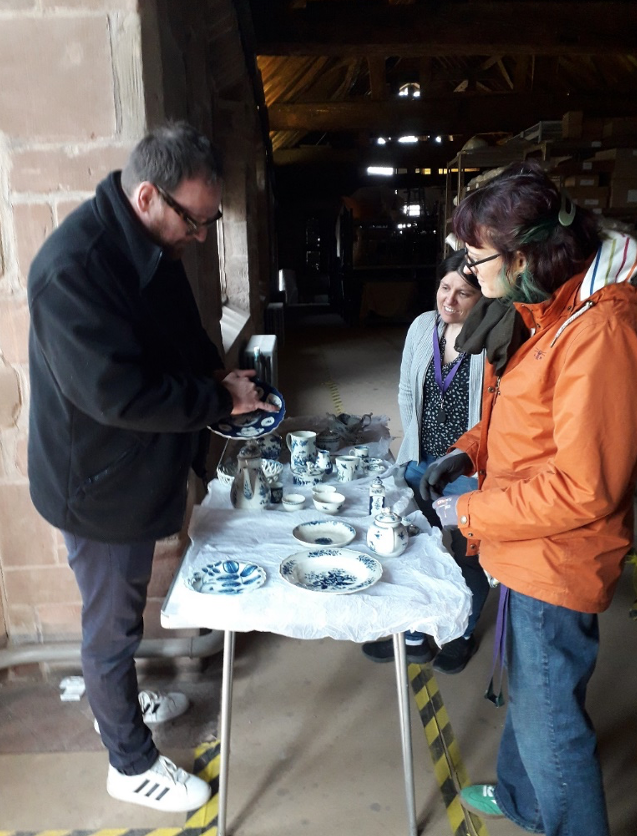
Image: Will Farmer inspecting ceramics with the Collections team
As part of the work the Collections team have been doing to prepare the collections to move to the new Collections Centre in the Ikea building we have been reviewing a number of collections to better understand their relevancy and significant to Coventry. This is good practice in the museum sector and has become a key part of collections management, carried out by museums of all types, from national institutions like the Science Museum to regional and local museums.
One of the collections we are reviewing is the Herbert’s ceramics collection, which consists of several hundred items, but which we know very little about and has not been on display for many years. We recently met with Will Farmer from Fielding’s Auctioneers and BBC’s Antique’s Roadshow, who agreed to share his expertise and advise us on what we should retain and what could be disposed of.
We focused on a collection of about 160 items which were owned by Christopher Cash (1861-1925), a member of the famous ribbon weaving family and prominent Coventry citizen. The collection is currently stored in one of our offsite stores, where we met with Will. We examined each item individually and Will told us about when and where it was made, who made it, how it was used and about the design or ‘pattern’. It emerged that most of the pieces were made in the mid-1700s by Worcester or Caughley pottery in imitation of porcelain from China. A small number of pieces in the collection were imported from China, but the vast majority were made in Britain.
This means that when Christopher Cash collected it in the late Victorian period, it was about 150 years since it was produced. Will explained that there was a late Victorian trend for collecting 18th century blue and white china as part of the Aesthetic Movement in a reaction to the ‘fussiness’ of much late Victorian design. People who were part of this movement wanted to escape the ugliness and materialism of the Industrial Age by acquiring or producing beautiful artefacts. They also wanted to demonstrate their good taste and the items would have been for display not for use. This tells us quite a lot about Christopher Cash as a person and enables us to use the collection to tell his story in future displays.
With Will’s help we have selected around 30 items from the collection to be retained. This is now a much more manageable collection and we can look after it more effectively. We also know a lot more about it and can use it to tell different stories. For example, the influence of China on British and European tastes and fashions, and the trade between Europe and China. We have retained several items, including tea cups and saucers, a tea caddy and a sugar bowl, which relate to tea and coffee drinking, which became very popular in the 1700s, and reflects trade links with places like India and China. This is very much a story about empire and colonialism and touches on the Transatlantic slave trade in which Britain played a major role.
Other items in the collection also revealed fascinating stories. Will explained that the raised pattern on one of the plates is known as the Blind Earl pattern. This was named after George William Coventry, the fifth Earl of Coventry (1722-1809), who lost his sight in a hunting accident in 1780. It is said that the Earl commissioned the Worcester Porcelain Manufactory to create a service with raised decorations so he could still appreciate the pieces through touch. Some historians suggest that the hunting accident story might be a fabrication to explain hereditary blindness within the family, as the pattern probably existed before the Earl's request. Whatever the truth of the story, the object can now be interpreted as a rare example of something from the 1700s that was produced or adapted to cater for someone with a disability.
The links and connections revealed through working with Will have shed new light on the collection which will enable us to tell more inclusive and engaging stories that a more diverse range of people can relate to. The collection will also be much easier to store and manage when we get into the new Collections Centre and will be more accessible to staff and researchers in the future.
A list of the items we no longer wish to retain will go to the Culture Coventry board and then to the City Council for consideration. If our recommendations are approved the items will then be disposed of in accordance with ethical guidelines issued by the Museums Association. They will first be offered as a transfer to other museums or similar organisations where they will be more relevant to the collections. If there are items which no public facing organisation would like as a last resort may be auctioned. Any funds gained from auction will be ring-fenced and used to benefit the museum collections, either through the purchase of new acquisitions or investing in equipment and materials to improve the long-term storage and care of the collections.
This has been great example of what can be achieved through a process of review and rationalisation of a collection and really highlights the benefits of engaging in this process.